Investing Guides
What Are Dividends? The Complete Guide to Dividend Investing
How dividends work, when investors are paid, dividend yield, reinvestment, taxes, risks and long-term strategies.
Key takeaways
- Dividends are shareholder distributions, not guaranteed interest or free money.
- Dividend yield is not total return; unusually high yields can signal risk.
- Check cash flow, earnings, debt and valuation before trusting a payout.
- Reinvesting dividends may support compounding but does not remove risk.
- Taxes, fund structure and investment goals vary across investors.
What is a dividend?
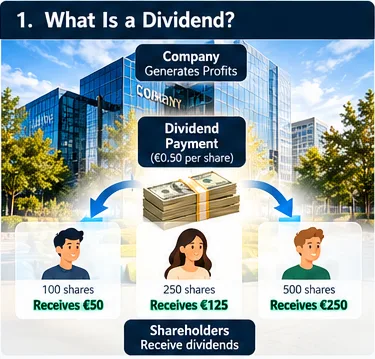
A dividend is a distribution of value from a company to eligible shareholders, most commonly in cash. If a company declares €0.50 per share and you own 100 eligible shares, you receive €50 gross. You keep the shares, but the company has distributed cash: the payment is not newly created wealth. Unlike contractual bank interest, ordinary dividends are not guaranteed.
Why companies pay dividends
Companies may invest in growth, repay debt, buy back shares, hold reserves or distribute cash. Mature businesses may return a portion of cash to shareholders; rapidly expanding businesses may reinvest it. Neither choice automatically signals a better investment. Sustainable capital allocation and the price paid matter.
Declaration, ex-dividend, record and payment dates
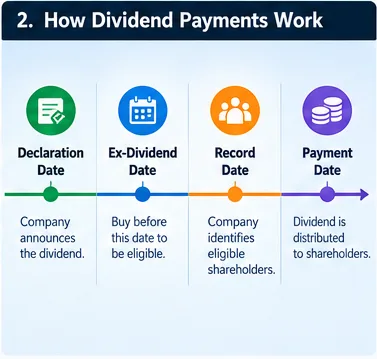
Declaration date: announcement of dividend terms. Ex-dividend date: shares begin trading without entitlement to the upcoming ordinary dividend. Record date: shareholder eligibility recorded under settlement rules. Payment date: distribution of cash. For ordinary US-listed shares, buying before the ex-dividend date generally qualifies; buying on or after it generally does not. Special dividends and other markets may differ.
How often are dividends paid?
Distributions may be monthly, quarterly, semi-annually, annually or special one-off payments. Frequency is not itself a measure of investment quality. Four quarterly payments totalling €2 per share generally represent the same annual cash amount as twelve monthly payments totalling €2.
Dividend yield explained
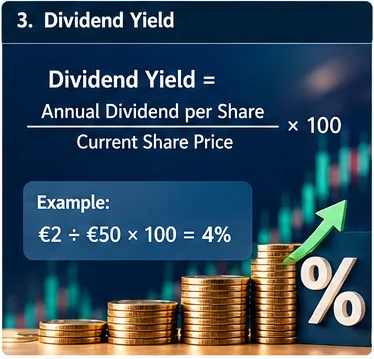
Dividend yield = annual dividend per share ÷ current share price × 100. A €2 annual dividend on a €50 share implies a 4% yield. If the stock falls to €40 without an immediate dividend change, the indicated yield rises to 5%—possibly because of increasing business risk. Distinguish trailing payments from forward estimates. Yield is not a promise of future income or total return.
Yield on cost
Yield on cost = current annual dividend per share ÷ original purchase price × 100. If a share was bought for €40 and now distributes €3 annually, yield on cost is 7.5%. It describes the original investment, not whether the stock is attractively valued today.
Are dividends free money?
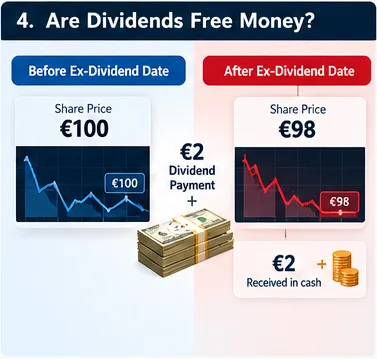
No. A dividend moves value from a company to shareholders. All else equal, on the ex-dividend date the market price tends to adjust by approximately the distribution, although normal market movements can mask it. Illustratively, €100 of stock may become about €98 of stock plus €2 of dividend entitlement. Buying just before the ex-dividend date does not guarantee a profit.
Dividend income versus total return
Total return reflects both share-price changes and distributions. In a simplified one-year example, an 8% price rise plus dividends equal to 3% of the starting value produces approximately 11% before costs. A 15% price decline plus 6% in dividends produces approximately −9%. A company that pays no dividend can still outperform a dividend payer.
Dividend payout ratio
Payout ratio = dividend per share ÷ earnings per share × 100. A €2 dividend supported by €5 earnings per share implies 40%. Ratios must be compared with the business model and financial cycle. A ratio above 100% calls for investigation but one-off accounting factors can distort reported earnings.
Free cash flow and coverage
A common simplified measure is free cash flow = operating cash flow − capital expenditures. If free cash flow is €1 billion and cash dividends total €400 million, payouts equal 40% of that cash flow. Examine trends, debt maturities, reinvestment needs, working-capital swings and sector-specific accounting—not a single year's ratio.
Dividend growth and inflation
Dividend growth investing emphasises companies that can raise payouts sustainably. A hypothetical €1 annual dividend growing 6% each year reaches roughly €1.79 after ten years. Real increases are neither smooth nor guaranteed, and inflation can reduce real purchasing power.
Dividend reinvestment and DRIPs
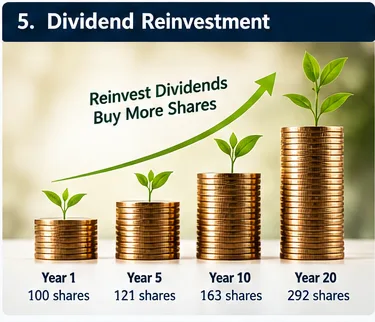
Reinvesting dividends buys additional shares or fund units. For example, 100 shares paying €1 each provide €100 gross; at €50 per share this could buy two more shares before costs and taxes. Those shares may also earn future distributions. Automatic dividend reinvestment plans (DRIPs) can simplify the process but do not remove market risk or tax obligations.
Compounding: an illustrative calculation
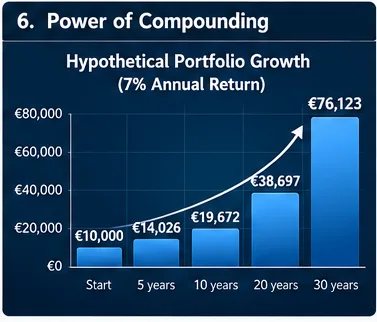
An initial €10,000 earning a hypothetical constant 7% annual total return with complete reinvestment, no fees and no taxes becomes about €14,026 after 5 years, €19,672 after 10, €38,697 after 20 and €76,123 after 30. This is a mathematical model, not a dividend-yield forecast or expected market outcome. Real-world returns fluctuate.
Dividend stocks versus growth stocks
Dividend-focused investing prioritises distributed cash; growth investing often emphasises reinvestment and capital appreciation. The distinction is imperfect because companies can grow while paying dividends. Consider valuation, diversification, risk and future total return rather than treating the strategies as opposites.
What are dividend ETFs?
Dividend-focused exchange-traded funds hold a basket of securities selected using a dividend-related strategy. Diversification can reduce exposure to one company, not eliminate market risk. Fund distributions may include dividends and, depending on the structure, other components. Review the prospectus, fees, index methodology, holdings, distribution policy and taxation.
Accumulating vs distributing ETFs
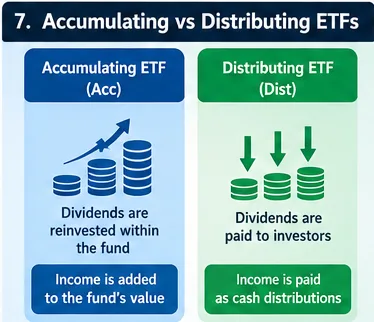
A distributing (Dist) ETF pays eligible distributions to investors according to its policy. An accumulating (Acc) ETF generally reinvests received income internally. Both may hold dividend-paying companies. Neither share class is universally superior, and accumulating funds are not automatically tax-free in every jurisdiction.
Dividend traps
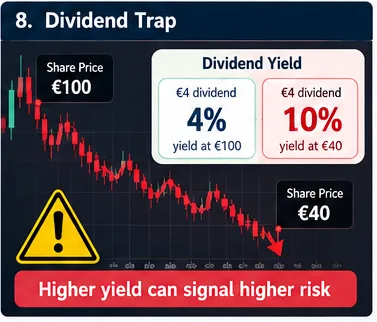
A company paying €4 annually on a €100 share yields 4%. If the price collapses to €40 before its dividend is reduced, the displayed yield becomes 10%. If the board cuts the payout to €1, the yield at €40 becomes only 2.5%. High yields can indicate deteriorating finances; investigate cash generation, leverage, demand and dividend sustainability.
How to evaluate a dividend company
First understand its products, customers, competition and long-term demand. Then examine revenue, operating margins, cash flow, debt, liquidity, capital expenditure and earnings quality. Check past dividend cuts, payout policy and whether distributions are covered through economic cycles. Finally compare the stock's valuation with realistic risks and growth prospects. A great business can be a poor purchase at the wrong price.
Dividend Aristocrats and Kings
The S&P 500 Dividend Aristocrats index uses eligibility requirements that include at least 25 consecutive years of dividend increases among qualifying S&P 500 constituents. 'Dividend King' is a common informal label for 50 consecutive years of increases. These describe history—not guaranteed future payouts. Membership and company status should be verified against current methodology.
Main risks
Dividend cuts reduce expected income. Capital losses may outweigh distributions. Business disruption can weaken profits. Sector concentration can amplify downturns. Interest rates influence relative asset attractiveness and valuations. Currency movements, taxes, fund fees and conversion costs reduce net returns. Dividends are not equivalent to insured bank deposits.
How are dividends taxed?
Taxation depends on residence, investment type, country of source, treaty eligibility and account structure. US-source dividends paid to many non-US individuals are subject to a default 30% withholding rate, potentially reduced by treaty; Form W-8BEN commonly documents qualifying foreign status. Home-country taxes and reporting may still apply, potentially with credits or relief. For example, 15% withholding on €100 gross leaves €85 initially, not necessarily the final after-tax amount. Reinvestment does not automatically prevent taxation. Always consult local official guidance.
Can you live off dividends?
Suppose someone wants €12,000 gross annual income at a hypothetical 4% distribution yield. A simple calculation suggests €12,000 ÷ 0.04 = €300,000 in invested capital. This ignores dividend cuts, share-price losses, inflation, taxes and costs; it is not a sustainable withdrawal forecast. A 4% dividend yield is also not the same as the 4% retirement withdrawal rule.
Should beginners only buy dividend stocks?
Not necessarily. A dividend-only approach can exclude successful non-paying companies and concentrate a portfolio in a few industries. Consider goals, time horizon, emergency savings, costs, diversification, risk tolerance and total return. Broad index funds can provide exposure to both paying and non-paying companies, though all stock-market investments can lose value.
Common mistakes
- Chasing the highest yield without examining the company's finances.
- Confusing dividend payments with investment profit.
- Buying immediately before the ex-dividend date expecting free money.
- Ignoring valuation, leverage, free cash flow or capital expenditure.
- Assuming historical increases will continue forever.
- Overlooking tax withholding, foreign exchange or ETF fees.
- Holding a highly concentrated portfolio of income stocks.
- Assuming accumulating ETFs avoid all taxes.
Frequently asked questions
Do all stocks pay dividends?
No. Some companies reinvest all available earnings.
Are dividends guaranteed?
No, regular ordinary dividends can be reduced, suspended or cancelled.
Do I need to hold shares for a year?
Generally not for ordinary dividend entitlement; relevant dates and market rules apply.
Can I keep my shares after receiving a dividend?
Yes.
Is 10% dividend yield necessarily better than 3%?
No, it may reflect risk of a payout cut.
Can dividend reinvestment be taxable?
Yes, depending on jurisdiction.
Is a monthly dividend better than a quarterly one?
Frequency alone does not indicate a better return.
Do accumulating ETFs hold dividend-paying shares?
They may; they generally retain and reinvest the fund's received income internally.
Can a company pay dividends during a loss-making year?
Sometimes, subject to law and available resources, but it deserves financial scrutiny.
Final thoughts
Dividends can provide useful income, but they are only one part of a shareholder's return. Sustainable cash generation, capital allocation, diversification, valuation and investment costs matter much more than an impressive headline yield. Ask not only 'How much does this stock pay?' but also 'Can the business create lasting value at the price I am paying?'
Educational content only; not personalised financial or tax advice. Numerical examples are hypothetical. Editorial reference: 17 October 2026.
Sources & references
Found an error? Contact us with the source and passage to correct.