World Affairs · News
Could the Strait of Hormuz Lose Its Strategic Role? HSBC CEO Points to New Oil Routes
New pipeline investment could reduce dependence on a critical oil chokepoint—but official energy data reveal why replacing Hormuz will be difficult.
What happened?
HSBC Group Chief Executive Georges Elhedery said on October 20, 2026 that investment in alternative energy-transport infrastructure could make the Strait of Hormuz much less important within about five years. Speaking at an event in Dubai, he said investment in alternative routes could reduce reliance on the narrow waterway. Reuters, October 20.
The remark is a forward-looking assessment, not a statement that the strait is already replaceable or that proposed infrastructure will necessarily be finished by 2031. The difference matters. Building pipelines and ports takes years, and new routes need enough capacity to move oil at scale.
The backdrop is the 2026 Middle East conflict, which has disrupted energy shipments. Gulf exporters are looking for ways to keep oil moving even when maritime routes are unsafe.
Why a narrow sea passage matters to the global economy
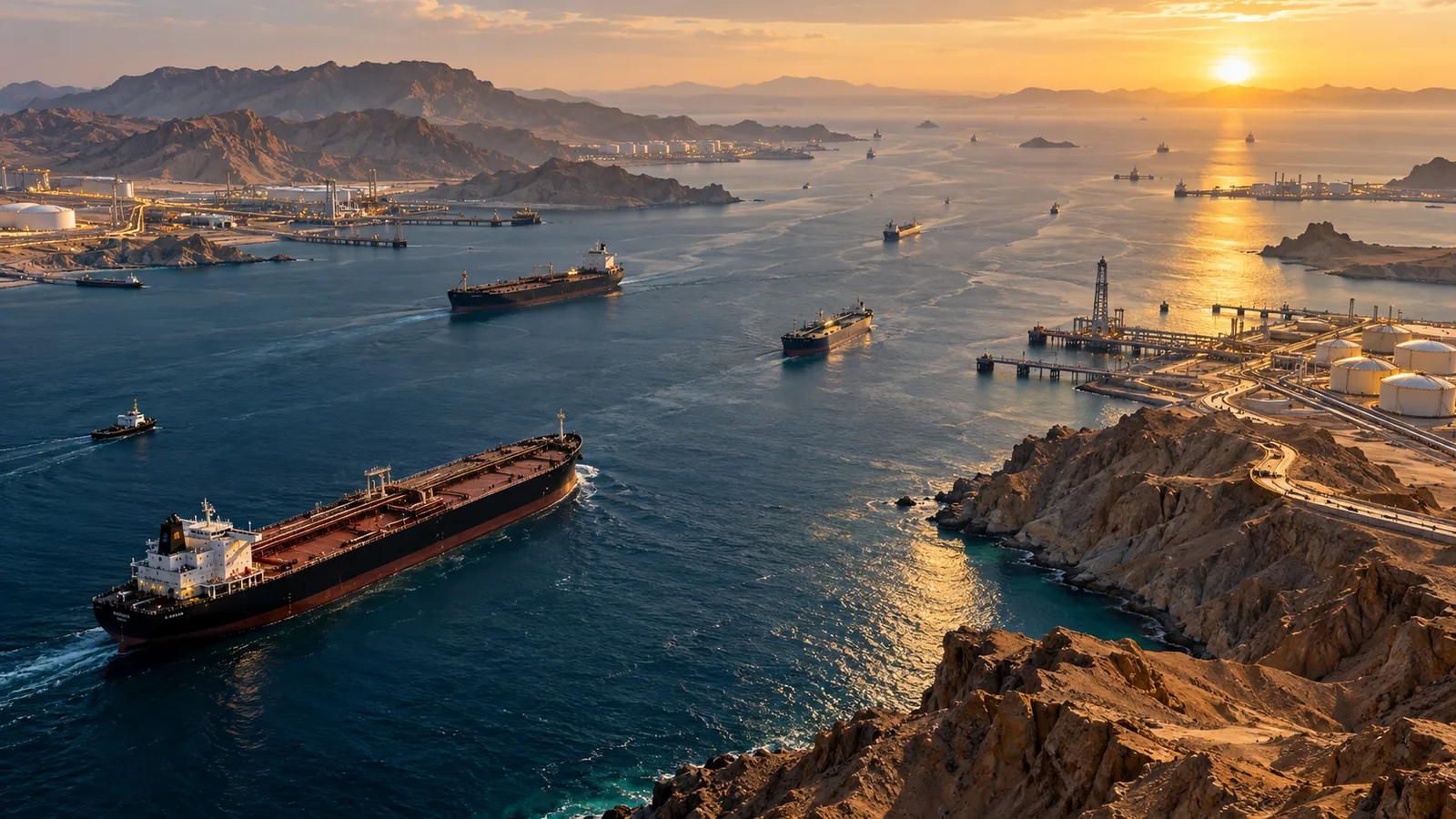
Located between Iran and Oman, the Strait of Hormuz links the Persian Gulf with the Gulf of Oman and international shipping lanes. Oil and liquefied natural gas (LNG) from several Gulf exporters depend heavily on this route to reach global customers.
The US Energy Information Administration (EIA) reported that around 20 million barrels per day of oil moved through Hormuz on average in 2024—approximately 20% of global petroleum-liquids consumption. These figures describe 2024, not shipping conditions today.
Separately, the International Energy Agency (IEA) estimates that around a quarter of global seaborne oil trade transited the strait in 2025. About 80% of the oil and petroleum products transported through the waterway that year were headed to Asia. The IEA says the waterway carried roughly one-fifth of global LNG trade in 2025.
These figures have different denominators: a share of global petroleum consumption, a share of seaborne oil trade and a share of LNG supply are not interchangeable. Together, however, they explain why interruptions can affect shipping, refineries, energy prices, Asian importers and inflation far beyond the Gulf.
Could pipelines really replace the strait?
There are already ways to export some Gulf crude without sailing through Hormuz. Saudi Arabia's East–West pipeline connects production facilities near the Gulf to the Red Sea coast. The United Arab Emirates has a pipeline to the Fujairah export hub on the Gulf of Oman.
But having a pipeline is not the same as having sufficient unused capacity to replace all disrupted tanker traffic.
In a June 2025 analysis, the EIA estimated that about 2.6 million barrels per day of additional capacity was then potentially available across Saudi and UAE pipelines in a disruption. The agency noted that both systems were already partly used in normal operations. This is an earlier capacity estimate, not a claim about their availability in October 2026.
The IEA's 2026 energy-security assessment estimates 3.5 million to 5.5 million barrels per day of capacity potentially available to move crude through existing Saudi and UAE bypass pipelines. This is based on a more recent market and operational context; it should not be added to the EIA's 2025 estimate, nor treated as guaranteed spare throughput at every moment.
Even if construction and upgrades expand those routes, not every Gulf producer has direct access to the same infrastructure. Pipelines require connections, land rights, pumping capacity and export terminals. Refinery products and LNG have their own logistics constraints: an oil pipeline cannot simply transport liquefied natural gas.
That makes a complete disappearance of Hormuz's strategic importance within five years far from assured. A more testable proposition is that new infrastructure could reduce the share of certain exports exposed to disruption.
The investment push behind the prediction
Reuters reported that HSBC pointed to $872 billion in project packages across the Middle East, North Africa and Turkey, within a broader $1.4 trillion infrastructure project pipeline compiled by construction-market intelligence provider MEED. Those amounts concern infrastructure broadly; they must not be mistaken for $1.4 trillion earmarked specifically for Hormuz bypass projects, nor for projects already financed and completed.
Elhedery's outlook highlights a shift in priorities: resilience, redundancy, port capacity and access to multiple export corridors can be valuable even when transport costs rise. Investors should distinguish proposed projects from committed expenditure and assets that have entered service.
Why the consequences reach beyond oil traders
For oil importers, especially in Asia, improved route diversity could eventually lower exposure to sudden shipping disruptions. But in the short term, freight, insurance, security and refining constraints may keep delivered energy expensive.
For exporters, additional routes could improve reliability and bargaining power, although large construction costs and alternative-route fees could offset some benefits.
For households and businesses, energy costs feed into transport, manufacturing, agriculture and freight. A change in the oil price is not identical to a change in petrol prices or inflation: taxes, exchange rates, refining margins and contractual timing all matter.
For LNG, the challenge is potentially greater because gas needs dedicated pipelines or liquefaction, storage and specialised shipping infrastructure. Crude export-route upgrades alone do not replace LNG terminals and trade routes.
The IEA has also documented extensive effects of the conflict on fuels and gas markets, reinforcing why energy security is a global economic concern. IEA energy-security overview.
What should readers watch next?
The crucial indicators are actual new pipeline capacity brought online, spare capacity available during normal operations, port and terminal completions, the volume of exports rerouted in practice, and insurance/freight costs. Announcements of investment are not proof of delivered infrastructure.
The outlook also depends on conflict developments and shipping conditions. A reduction in military risk might restore ordinary transit even while new infrastructure is under construction; continued disruption could make more expensive alternatives economically attractive.
Bottom line
The HSBC CEO's statement is newsworthy because it captures a possible structural change in world energy logistics. Yet the historical scale of Hormuz trade and the limitations of alternative infrastructure show why calling the waterway obsolete today would be misleading.
The key question is not whether Hormuz will suddenly stop mattering, but how much exposure global oil and gas markets can realistically diversify away from it—and how quickly.
Reporting cutoff: October 21, 2026, based on statements reported October 20. Historical EIA/IEA comparisons are identified by year. World in Stats independently wrote this explainer from the cited reporting and agency data; it is not an original interview or a prediction of future oil prices.
Sources & references
- Reuters — HSBC CEO on the Strait of Hormuz and alternative routes (20 October 2026)
- U.S. EIA — Strait of Hormuz oil flows and bypass pipeline capacity (16 June 2025)
- International Energy Agency — Middle East and global energy markets (2026)
- Reuters — Energy companies rethink export routes after disruptions (6 October 2026)
Found an error? Contact us with the source and the passage to correct.