Technology · News
Tesla's New Roadster Takes Flight in a Dramatic Test — What Could It Really Change?
Tesla demonstrated remarkable airborne manoeuvres and an ultra-quick acceleration run, but road legality, safety and commercial readiness remain unresolved.
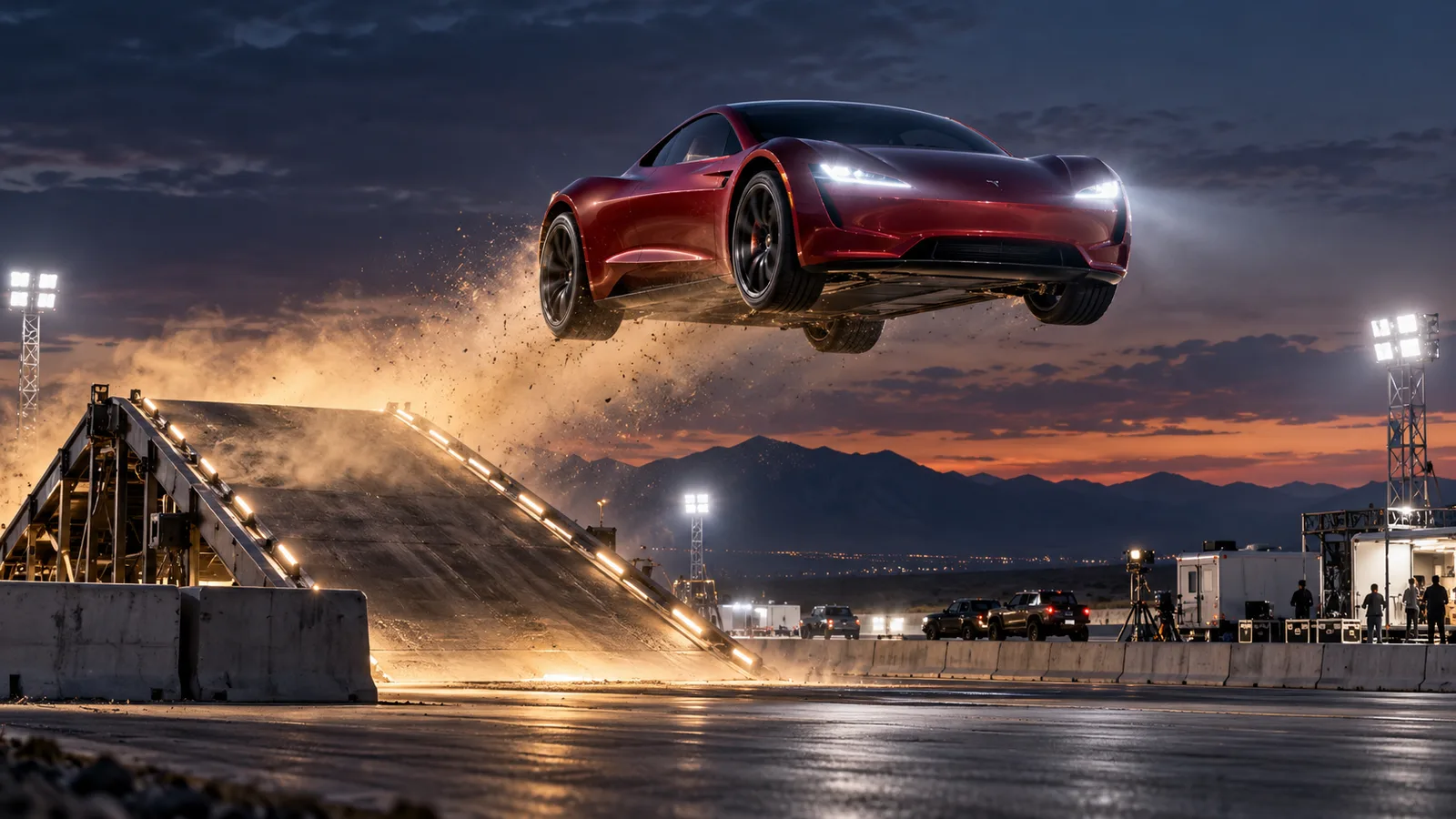
What actually happened at Tesla's Roadster demonstration?
Tesla's second-generation Roadster has performed extraordinary controlled stunts, but a short airborne jump is not the same as sustained flight or an approved road-going product. This distinction is crucial to interpreting the October demonstration.
On 15 October 2026, Tesla unveiled a prototype of its long-delayed second-generation Roadster at a SpaceX test facility in McGregor, Texas, near Waco. The demonstration was designed to show capabilities rarely associated with road cars: a short airborne manoeuvre, a mid-air rotation and an exceptionally rapid acceleration run.
According to reporting by Associated Press, Reuters, TechCrunch and The Verge, the demonstration vehicle used compressed-gas thrusters developed with SpaceX, alongside a suction system intended to increase grip for unusual manoeuvres. The vehicle used in the display was operated without a driver at the controls for safety. These were controlled demonstration conditions, not evidence that the system is safe or legal for ordinary roads.
The numbers behind the spectacle
Tesla presented a 0–60 mph acceleration time of about 0.81 seconds for the demonstration vehicle. That is approximately 0–97 km/h, but the figure describes a claimed demonstration result, not independently reproduced consumer-car performance.
The prototype's airborne manoeuvres were similarly limited demonstrations. The Tesla-provided event replay is included below in three chapter links, with the sequence and timings referenced to event coverage; chapter playback has not been independently tested in the live World in Stats site. A brief jump and controlled landing should not be confused with sustained flight, ordinary urban transport or a regulatory certification for an aircraft.
Tesla has indicated 2028 as a prospective production timeframe for the next-generation Roadster. That is a company target, not a confirmed delivery schedule. The model was originally announced in 2017 with production once expected in 2020, so the history of postponements matters when judging the latest timeline.
| Question | What has been reported | What remains unproven |
|---|---|---|
| Acceleration | Tesla demonstrated or reported an approximately 0.81-second 0–60 mph run | Independently repeatable results in a production vehicle |
| Airborne ability | Prototype performed short aerial manoeuvres using thrusters | Sustained flight or practical airborne passenger transport |
| Public-road use | Prototype was displayed at a controlled test venue | Approval under road-vehicle and any relevant aviation rules |
| Availability | Tesla indicated a 2028 production goal | Reliable delivery dates, full pricing and production specifications |
How does the technology work?
Conventional electric cars use traction motors to accelerate and tyres to transmit forces to the road. The Roadster demonstration adds aerospace-inspired systems: pressurised-gas thrusters to produce extra force and a suction arrangement to influence adhesion during extreme manoeuvres.
That distinction matters. The dramatic performance was not presented as the result of batteries and electric motors alone. Adding pressure vessels, valves, control systems and other specialised hardware may also create trade-offs involving weight, cost, maintenance and safety.
The exact operating limits and independently certified performance of a road-going version have not been established in the evidence reviewed for this article.
Could this change the automotive industry?
The clearest near-term implication is engineering experimentation and brand positioning, not the imminent arrival of flying family cars. Tesla and SpaceX are showing how expertise in propulsion and control systems might cross the boundary between automobiles and aerospace.
There are three possible areas of influence. First, the demonstration could stimulate new approaches to high-performance vehicle dynamics, even if its most extreme systems never become standard equipment. Second, it could intensify competition for specialist engineering talent and attention in the electric-supercar market. Third, it could renew discussion of how regulators should classify road vehicles equipped with unusual propulsion or airborne capabilities.
These are possibilities, not established outcomes. A successful stunt does not demonstrate that the technology can scale economically, work in diverse weather and traffic conditions, or meet the safety requirements for mass-market mobility.
The challenges Tesla still faces
Production is the first obstacle. The next-generation Roadster has been anticipated for years, and moving from a controlled prototype to a repeatably manufacturable, serviceable vehicle is a separate engineering challenge.
Safety and regulation are another. A vehicle designed for public highways faces different tests from a prototype used at a private aerospace facility. If any version were intended for sustained flight, additional aviation and operational questions would arise. Elon Musk and media reports have acknowledged that the most extreme configuration may not be road-legal.
The market is also uncertain. Even if a specialised version becomes available, its likely customers and economics differ radically from those of mainstream electric vehicles. It would be premature to treat the demonstration as evidence of a near-term transformation in mass transportation.
What happens next?
Watch for a technical specification sheet, reproducible performance tests, published safety evidence, regulatory clarification and a production timetable supported by actual manufacturing progress. These developments would be more informative about commercial readiness than another dramatic demonstration.
The central takeaway: Tesla showed an unusual aerospace-inspired Roadster prototype. It has not yet demonstrated that flying road cars are a practical, safe or commercially available transport category.
Editor's visual note: The cover is an AI-generated artistic illustration of a Roadster-style car in a controlled stunt setting, not an image captured at Tesla's actual October 2026 demonstration. The embedded event video links lead to third-party-hosted material and are provided for context.
Watch the demonstrations
Inverted ramp and airborne rotation
Jump over other vehicles
0–60 mph acceleration run
Sources & references
- Tesla — Roadster Event livestream, 15 October 2026
- Reuters — Roadster reveal and production timeline, 15 October 2026
- Associated Press — Roadster demonstration and safety limitations, 16 October 2026
- The Verge — Roadster reveal, 16 October 2026
- TechCrunch — Tesla reveals SpaceX-powered Roadster, 15 October 2026
Found an error? Contact us with the source and the passage to correct.